Author: Dr Saikiran

  • Neonatal Jaundice

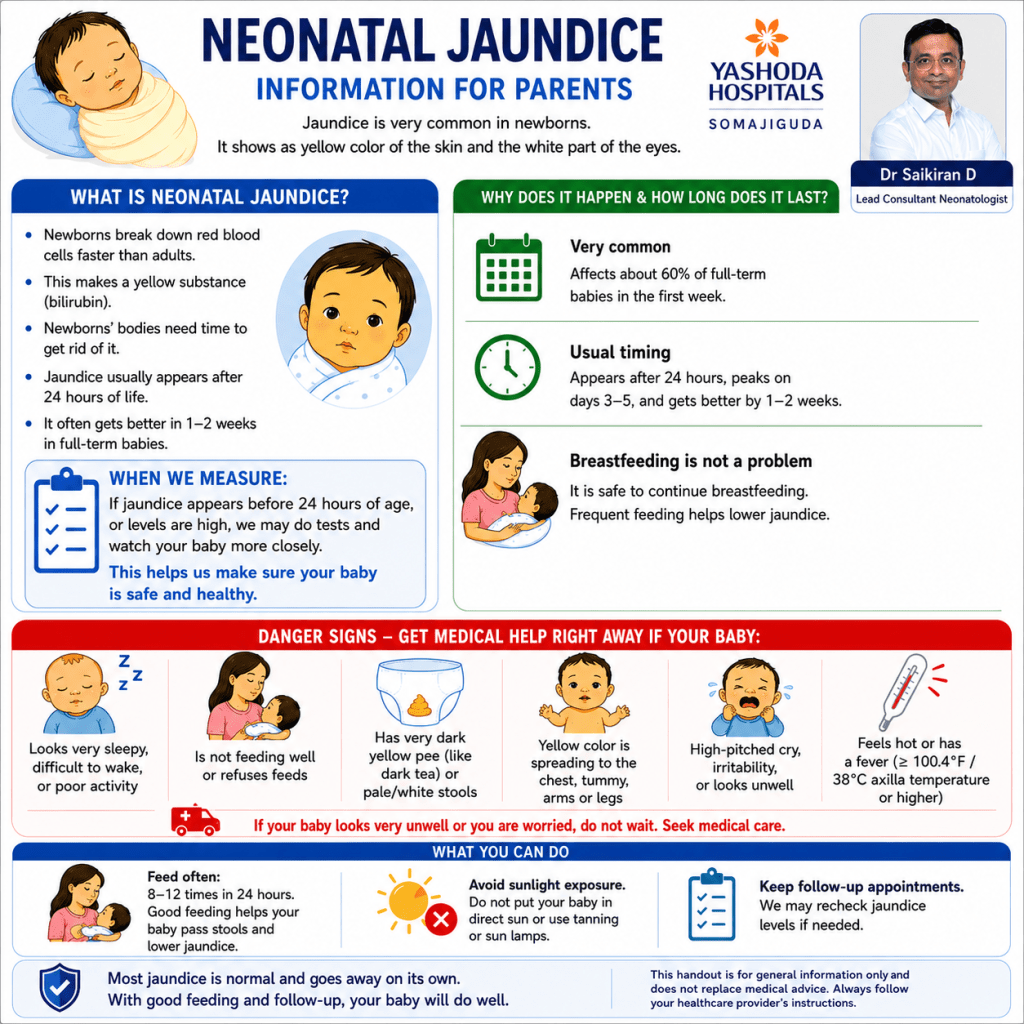
    💛 Newborn Jaundice: What Every Parent Should Know

    Seeing a yellow tinge on your newborn’s skin can be worrying, but jaundice is very common. Around 6 out of 10 healthy full-term babies develop jaundice during the first week of life, and most recover with good feeding and regular follow-up.

    👶 Seek medical attention immediately if your baby:
    • Becomes very sleepy or difficult to wake
    • Feeds poorly
    • Develops jaundice within the first 24 hours after birth
    • Has fever (axillary temperature ≥38°C)
    • Has pale stools or very dark urine
    • Looks increasingly yellow or unwell

    ❌ Do not expose your baby to direct sunlight as a treatment. The safest approach is early assessment by your healthcare provider.

    Early recognition and timely treatment can prevent complications and keep your baby healthy.


    #NewbornCare #NeonatalJaundice #ParentEducation #Breastfeeding #Neonatology #YashodaHospitals #DrSaikiranD

  • Fever in children: Friend or Foe?

    Parents are anxious and worried when their child is suffering from fever. In an hospital setting, children with fever are the most frequent cause of ER (emergency room) visits. It is also often the reason for overmedication with antipyretics and unnecessary antibiotics. There are many myths and misconceptions associated with fever in children. Thus, its important for any parent to have a rational and scientific understanding of fever.

    What is fever?

    Fever is an elevation of body temperature above the normal daily variation. The body temperature in children is not fixed and varies throughout the day. Often the body temperature increases depending on the environment, weather, activity and clothing. For clinical purpose, fever is typically defines as a core body temperature greater than 38 C or 100.4 F as measured in the axilla or mouth. Ear drum and forehead thermometer readings are not reliable.

    Why or how does fever happen?

    Fever is a response to the body’s thermostat (Hypothalamus) being reset to a higher set point by the pyrogens (microbes). Fever turns on the immune system of the body and helps it fight the microbes.

    Does a higher fever mean a sicker child?

    No, a higher fever does not mean a sicker child. The overall activity of the child (drinking fluids, playing) is more important than the reading on the thermometer.

    Does high fever cause febrile seizures?

    No, it is the rate of change of body temperature rather than the degree of fever which causes febrile seizures. Febrile seizures usually last less than 5 minutes and are more common in the 6 months to 6 years age group. Febrile seizures do not cause any permanent brain damage. Only extreme temperatures above 108F ( 42 C) can cause brain damage. Most children have febrile seizure even before parents realize that the child has fever.

    When is fever normal?

    In children above 3 months of age, any fever of less than 3 days. When the child is acting pretty normal (playing, eating, drinking). In many cases, fever reducing medications might be unnecessary. Medication to reduce fever is given when the child is not comfortable, she or he is very fussy and in pain. A comfortably sleeping child should not be woken up to give fever-reducing medication.

    When is fever abnormal or when should we visit a doctor?

    Any fever in infants less than 3 months old, fever in children that is lasting more than 3 days, any fever more than 104F and not coming down with medication. Child is not active (not eating, drinking and playful) and or difficult to arouse, difficulty in breathing, persistent vomiting, fever with skin rash. In children having any underlying chronic medical conditions, fever should not be ignored. Any time when you are worried, visit a doctor.

    What are the home care tips?

    1. Tepid water sponge (entire body) with room temperature water. Cold water will induce chills and aggravate fever.
    2. Encourage intake of oral fluids and physical rest.
    3. Dress your child with loose clothing to help their body radiate excess heat.
    4. If your child is uncomfortable, use paracetamol or ibuprofen based strictly on your pediatrician’s dosage instructions for your child’s weight.